Shoebill Stork: The Ancient Guardian of Africa’s Wetlands
Category: Birds | May 12, 2026
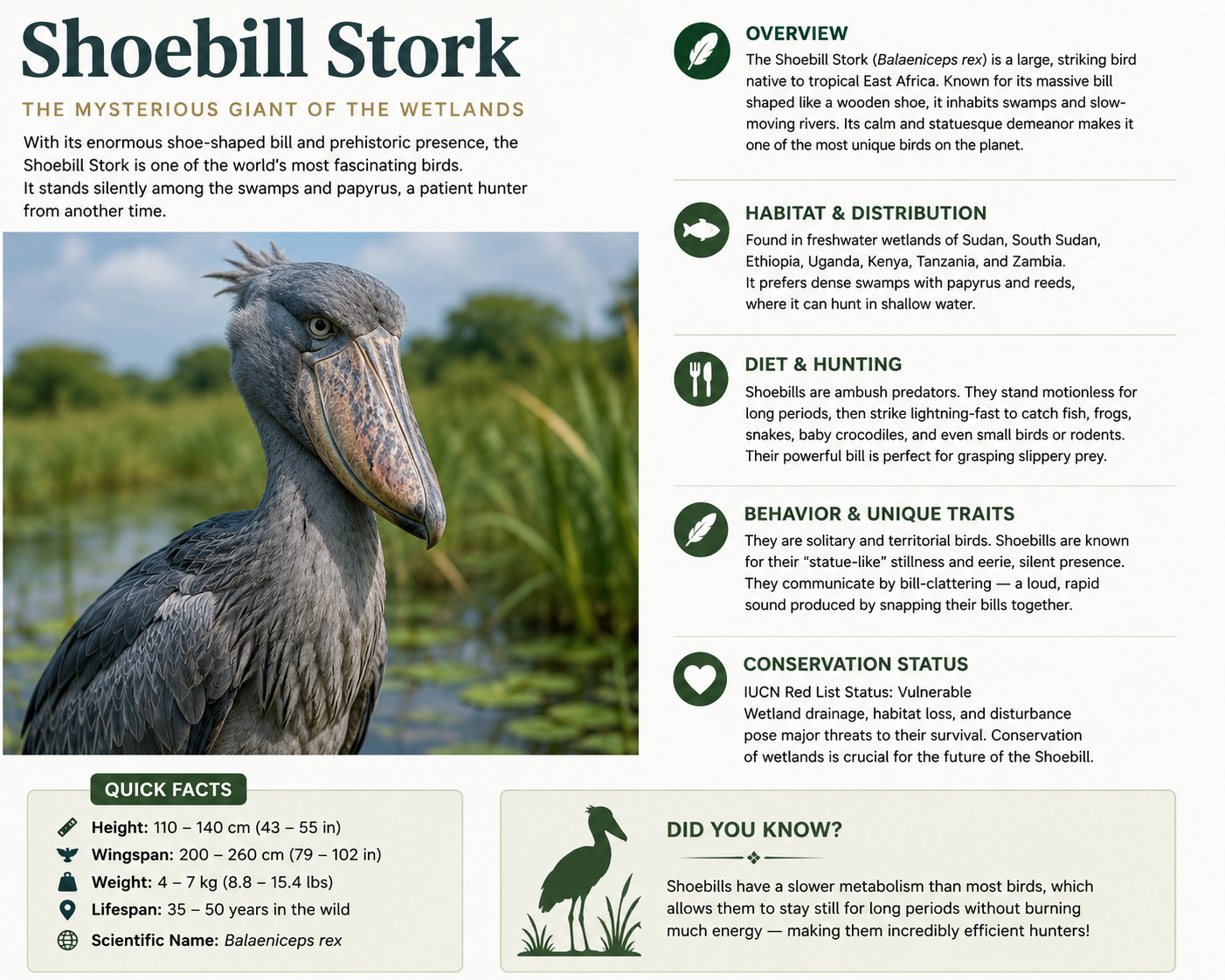
The shoebill stork feels like something the modern world accidentally forgot. Standing tall in the quiet wetlands of East and Central Africa, this enormous bird moves with a calm, almost unsettling confidence. Its massive shoe-shaped bill, pale piercing eyes, and slow deliberate movements give it the appearance of a creature from another era — as if a dinosaur quietly wandered into the present day and decided to stay. Seeing a shoebill in the wild is not just exciting; it feels strangely personal, like locking eyes with something ancient that has been watching the world long before humans arrived.
What makes the shoebill even more fascinating is the way it hunts. While most predators rely on speed or chaos, the shoebill relies on patience. It can stand completely motionless beside the water for incredibly long periods, waiting with almost unbelievable discipline. Then, in a split second, everything changes. The bird explodes into motion, striking the water with terrifying precision to catch fish, frogs, snakes, and even small crocodiles. Watching it hunt feels almost unreal — less like observing a bird and more like witnessing a quiet master that has perfected survival over millions of years.
Despite its intimidating appearance, the shoebill is not aggressive by nature. In many ways, it seems more thoughtful than fierce. These birds prefer solitude and peaceful swamp environments where the sounds of civilization cannot reach them. They spend much of their lives surrounded by reeds, shallow waters, and silence. Instead of melodic bird songs, shoebills communicate through loud bill-clattering noises that echo across the wetlands like distant drums. Their calm stillness and intense stare have made them famous online, but photographs rarely capture the strange emotional feeling people experience when standing near one in real life.
Shoebills are also deeply connected to the health of the wetlands they call home. By hunting fish and other aquatic animals, they help maintain balance within these fragile ecosystems. But the world around them is changing quickly. Wetlands are disappearing due to deforestation, farming, and human expansion, leaving fewer safe places for shoebills to survive. Illegal wildlife trade and habitat destruction continue to threaten their future. Every disappearing swamp is not just a loss for one bird species — it is the slow erasing of an entire hidden world filled with life.
There is something humbling about the shoebill stork. In a world obsessed with speed, noise, and constant movement, this silent giant survives through patience, stillness, and quiet focus. It reminds us that nature does not always need to roar to be powerful. Sometimes the most unforgettable creatures are the ones that simply stand silently in the shadows, watching the world move around them while carrying the weight of ancient time in their eyes.
🌴 Jungle Chatter
Most popular reactions:
No reactions yet.